
Backup-power work should start from the loads that must remain on and the backup time required. UPS, batteries, generators and transfer equipment need to be sized and wired as one coordinated system.
Backup-power work should start from the loads that must remain on and the backup time required. UPS, batteries, generators and transfer equipment need to be sized and wired as one coordinated system. Record the intended backup loads so later battery or inverter changes can be checked against the original requirement.
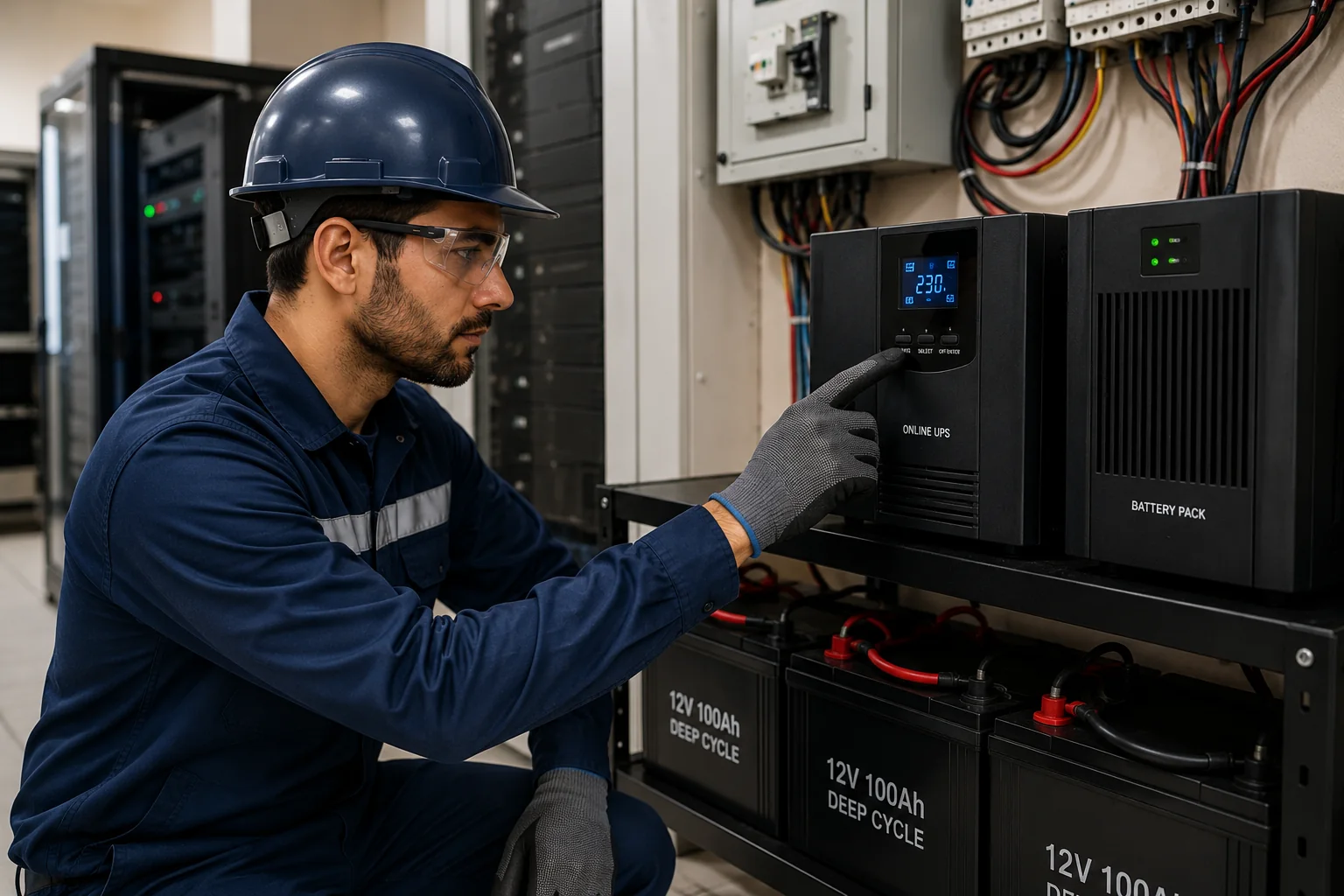
Our Power Backup Services
UPS Installation
UPS selection starts with the equipment that must stay powered and the required backup duration. Inverter rating, battery capacity, charging current and safe changeover wiring should be matched as one system.
- List only the loads that genuinely need backup.
- Calculate expected running watts and starting loads.
- Match battery capacity to the required backup duration.
- Provide ventilation and accessible isolation for batteries.
- Test mains failure and restoration after installation.
- List only the loads that genuinely need backup.
UPS selection starts with the equipment that must stay powered and the required backup duration. Inverter rating, battery capacity, charging current and safe changeover wiring should be matched as one system. Record the intended backup loads so later battery or inverter changes can be checked against the original requirement.
UPS Repair & Maintenance
UPS faults may involve batteries, charging, inverter electronics, relays, cooling or external wiring. Battery replacement should not be assumed until charging and load behaviour are checked.
- Check battery voltage and condition under load.
- Verify charging voltage and current.
- Inspect fans, terminals and signs of overheating.
- Test transfer between mains and backup modes.
- Confirm the connected load is within the unit's rating.
- Check battery voltage and condition under load.
Inverter UPS Systems
An inverter/UPS setup should be sized around continuous load, surge demand and expected backup time. Battery chemistry, charging profile and ventilation affect both performance and service life.
An inverter/UPS setup should be sized around continuous load, surge demand and expected backup time. Battery chemistry, charging profile and ventilation affect both performance and service life. Record the intended backup loads so later battery or inverter changes can be checked against the original requirement.
- Measure or estimate realistic connected load.
- Allow for motor or compressor starting surges where relevant.
- Use a compatible battery bank and charging profile.
- Provide safe DC protection and cable sizing.
- Keep the unit in a ventilated, serviceable location.
Battery Installation & Replacement
Backup batteries need compatible voltage, capacity, charging settings and safe cable connections. Mixing old and new batteries or mismatched units can reduce useful backup time.
- Confirm battery type, voltage and bank configuration.
- Inspect terminals and DC cables for heat or corrosion.
- Check charger settings against the battery specification.
Backup batteries need compatible voltage, capacity, charging settings and safe cable connections. Mixing old and new batteries or mismatched units can reduce useful backup time. Record the intended backup loads so later battery or inverter changes can be checked against the original requirement.
Generator Installation
Generator installation involves electrical changeover, earthing, exhaust, ventilation, fuel safety and the starting load of connected equipment. The generator rating should reflect real demand rather than only total connected wattage.
- List essential loads and their starting requirements.
- Plan safe manual or automatic changeover.
- Provide suitable earthing and protective devices.
- Locate exhaust and ventilation away from occupied areas.
- Test transfer and load behaviour before routine use.
- List essential loads and their starting requirements.
Generator Repair & Service
Generator problems can come from fuel, starting, charging, engine condition, alternator output or control wiring. Electrical output should be checked before assuming the fault is only mechanical.
- Check starting battery and charging condition.
- Verify output voltage and frequency under load.
- Inspect breakers, terminals and control wiring.
- Review fuel and engine symptoms separately from electrical faults.
- Test with a suitable load after repair.
- Check starting battery and charging condition.
ATS (Automatic Transfer Switch)
An ATS must coordinate the utility supply, generator start signal, interlocking and load transfer without allowing unsafe backfeed. Ratings and control logic should match the installation.
- Confirm ATS current rating and supply arrangement.
- Verify mechanical/electrical interlocking.
- Check generator start and stop control wiring.
Load Balancing & Management
Load management is used when circuits, phases or backup equipment are unevenly loaded. Measurements should identify where the imbalance occurs before circuits are moved or equipment is resized.
UPS & Power Backup Brands
Battery Brands
Power Backup Pricing Guide
| Service | Planning / Quote Note |
|---|---|
| UPS Installation (basic) | Quoted after scope check |
| UPS Installation (with wiring) | Quoted after scope check |
| UPS Repair | Quoted after scope check |
| Battery Replacement (labor) | Quoted after scope check |
| Tubular Battery (185Ah) | Quoted after scope check |
| Generator Installation | Quoted after scope check |
| ATS Installation | Quoted after scope check |
Planning a Power Backup System
- List essential loads.
- Confirm expected backup duration.
- Check cable, battery and protection condition.
- Verify changeover and charging operation.
- Test the system under a realistic load.
Discuss a Power Backup Requirement
Discuss a Power Backup Requirement: Backup-power work should start from the loads that must remain on and the backup time required. UPS, batteries, generators and transfer equipment need to be sized and wired as one coordinated system.